🔧 Developer beta launches 30 September 2026 — free for developers. Flash your own ESP32-S3 and test it. Learn more →
Upload your secrets to Google Drive. Nobody can open them. Not even us.

This is not a privacy policy promise. It is an architectural property: lake8.dev cannot decrypt customer files because the key material was never transmitted to us. Not by choice — by construction.

A user buys a Crypt-in dongle, encrypts their files, uploads everything to Google Drive — publicly — and destroys the dongle. Four years later they buy a €5 chip, type 24 words, and the files open. In those four years the data sat in plain sight, mathematically inaccessible to everyone. Including us.

Not even to the owner, without that piece of paper. Nobody memorises 24 random words, so the secret is not in a person's head — which is a smaller and more honest claim than immunity from coercion, something our threat model says no technology provides.


Investor & Partner Overview

Crypt-in — July 2026

This document is public and intentionally transparent. Radical transparency is a design principle at lake8.dev, not a pitch strategy.

Product definition

Crypt-in is a hardware-backed root of trust commodity. The root secret never leaves the dongle. The computer never possesses the key.

Personal

€30/year

File encryption into .crin containers.

Explorer

€50

Encrypted file manager.

SDK Developer Support

€150 + €100/year

Dedicated support for HID protocol and .crin integration. The SDK itself is Apache-2.0 and free.

Vault

€100/month

Self-hosted, vendor-blind document server.

What does not exist today (verified July 2026)

CapabilityCrypt-in
Commodity DIY hardware (~€5)yes
Physical hardware kill switchyes
Instant kill switch on USB removal eventyes
Universal cross-platform .crin formatyes
Vendor-blind self-hosted Docker vaultyes
Granular SME pricingyes
EU manufacturer — GDPR and CRA scopeyes
Structurally zero CAC (agentic-first)yes

Competitive research conducted July 2026. No product currently combines all of the above. This is a claim about the combination — each element exists elsewhere in isolation.

Why the architecture matters

K_attestation — anti-clone protection

Each physical ESP32-S3 chip generates a unique hardware attestation key (K_attestation) from hardware entropy, independent from the recoverable BIP-39 seed. The license server binds activation to K_attestation — a clone built from the same seed is detected and blocked.

Verified on real hardware: Krypt@9c756da, Krypt@d3e71df.

Vendor-blind by construction

What reaches lake8.dev and what does notK_root, K_attestation and the recovery seed never leave the dongle. Session keys, file keys and .crin files stay on the user device and are never transmitted. lake8.dev always receives payment data and the public half of K_identity. Personal data is a choice: in anonymous activation lake8.dev receives no email, no name and no tax ID; in registered activation it receives all three.DongleUser devicelake8.devK_rootK_attestationK_recovery seednever leave the chipNEVER TRANSMITTEDK_sessionK_file.crin filesALWAYS RECEIVEDpayment dataK_identity pubkeyYOUR CHOICEMODE A — ANONYMOUSemailnametax IDMODE B — REGISTEREDemailname + surnametax ID (CF/VAT)The keys never leave the chip either way. What changes is only how much you tell us about yourself.

lake8.dev also receives the tax/VAT number where invoicing requires it. It never receives the root secret, the BIP-39 seed, encrypted files, session keys, the Vault master secret, or telemetry of any kind.

This is an architectural property, not a policy promise: the material required to decrypt was never transmitted, so no policy change or legal order can produce it.

Offline-first

The licence server is contacted at activation, then only for annual renewal and for transferring a licence to a replacement dongle — at most three times a year. There is no periodic check-in during normal use. lake8.dev could shut down tomorrow: already-activated dongles keep decrypting forever.

What exists today (not roadmap)

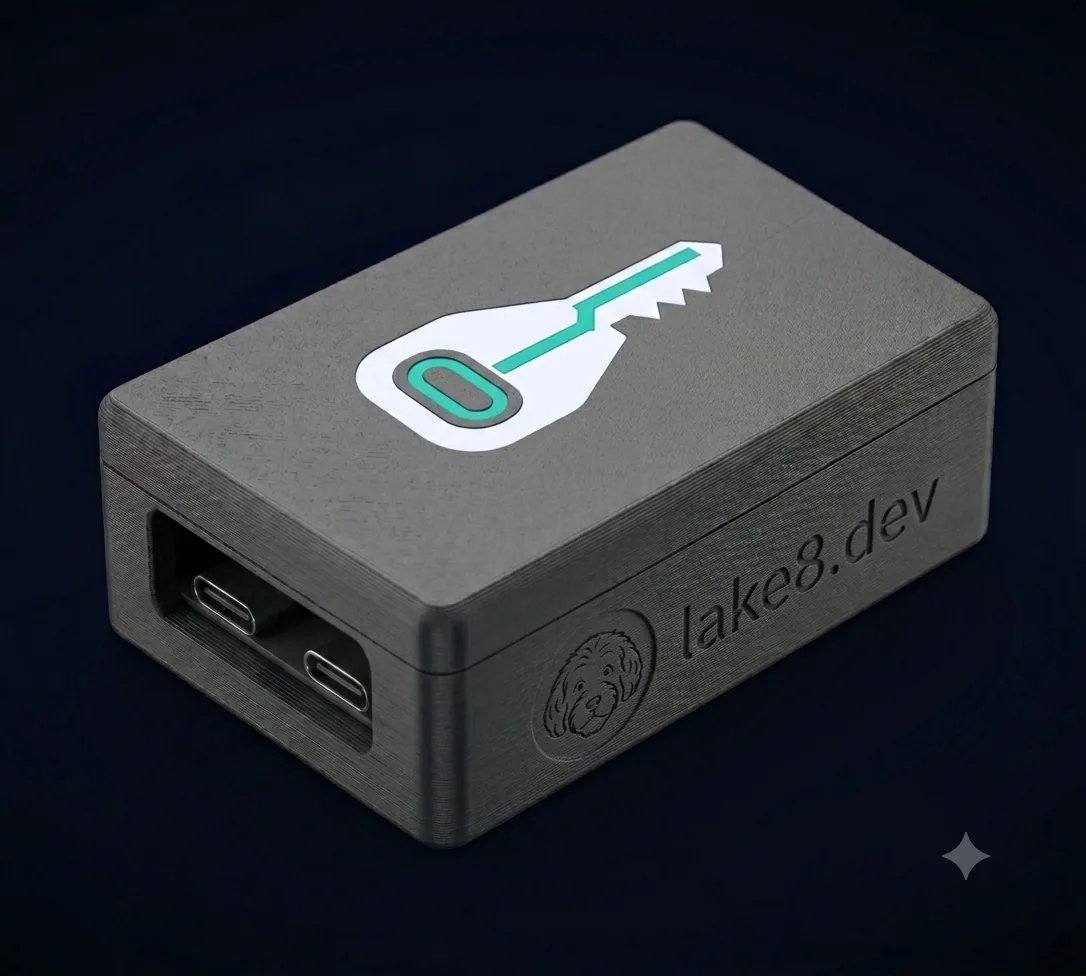
Crypt-in dongle prototype — render of the assembled anthracite case, ESP32-S3 dev board variant with two USB-C ports

Prototype render — ESP32-S3 in anthracite PLA case. Case design, not a photograph of a production unit.

In progress

Required before launch

Milestones & timeline

MilestoneStatusDate
Firmware K_attestation✅ CompleteJuly 2026
Licence server K_attestation✅ CompleteJuly 2026
HID end-to-end test (7/7)✅ CompleteJuly 2026
cryptin.lake8.dev live✅ CompleteJuly 2026
SBOM published (SPDX 2.3)✅ CompleteJuly 2026
Flash encryption + secure boot✅ CompleteJuly 2026
Secure boot verified on production hardware✅ CompleteJuly 2026
Windows client (Personal v1) — core flows (main window, PIN, serial recovery) verified on hardware. Setup, activation and payment wizards not yet exercised by an external user.✅ CompleteAugust 2026
Internal security audit (3 sessions) — 3 internal red team sessions conducted by lake8.dev using Claude Opus 5. Full report published at /security/red-team-2026-08/. Not equivalent to an independent third-party audit: that is planned from Q3 2027, subject to budget and enterprise demand, and is not a blocker for the April 2027 public launch.✅ CompleteAugust 2026
SDK open source (Apache 2.0) — code complete and licensed Apache 2.0 since August 2026. The repository is private until it opens at the developer beta; there is no public address yet.🔄 In progressOpens 30 September 2026
Red team (developer beta) — all developer beta participants are official red team members. Report findings to security@lake8.dev.🔄 In progressFrom 30 September 2026
Linux CLI client — CLI wrapper around CryptinSDK. .NET 9, cross-platform, Apache 2.0. cryptin encrypt / cryptin decrypt. Ships with the developer beta to cover all platforms. Fallback: 30 October 2026.⏳ PlannedTarget 30 September 2026
Python client — if ready earlier, it ships earlier. Apache 2.0. The Python files in tools/ today are an internal test harness, not a client.⏳ PlannedQ2 2027
Developer beta launch⏳ Planned30 September 2026
Public launch⏳ PlannedApril 2027
Independent protocol audit — subject to budget and enterprise demand. Not a blocker for the public launch.⏳ PlannedFrom Q3 2027

Dates for planned items are targets, not commitments. The four proofs below gate the public launch: if one of them is not demonstrated, the date moves.

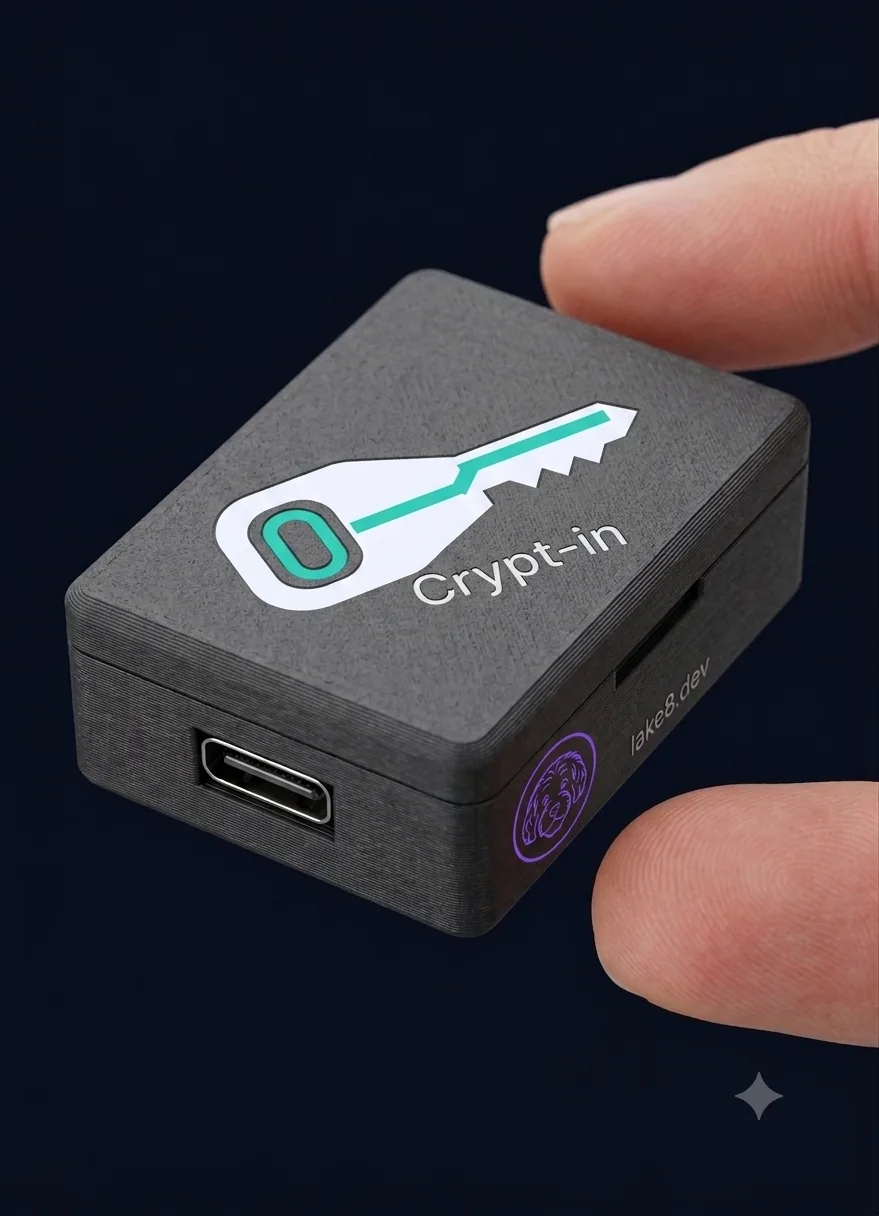
Crypt-in Kit Standard held between two fingertips, showing its actual size: an anthracite grey PLA case with a single USB-C port, the Crypt-in key logo on the lid and lake8.dev engraved on the side.

Kit Standard, render of the case design at true scale — it fits between two fingers, with an ESP32-S3 inside. Kits ship pre-flashed and tested; the factory test ends by erasing NVS, so the keys you use are generated at first boot in your hands, never in ours.

Four proofs before expansion

ProofMetric
Cryptographic.crin spec published with test vectors
SecurityIndependent protocol audit report
Usability10 non-technical users complete setup and recovery
Commercial50 Year-2 renewals on Windows

These are gates, not milestones. Expansion — multiplatform, Vault, SDK — happens only after all four are demonstrated.

When and how we raise

We are not raising now.

Crypt-in is bootstrapped. The infrastructure runs on lake8.dev's existing Raspberry Pi setup. Development cost is near zero — the founder directs architecture, Claude Code accelerates implementation.

We will consider external capital after:

At that point, external capital makes sense to fund: independent security audit, CE marking for Kit Pro, and vertical marketing (legal, medical, manufacturing).

We are not open to equity dilution.

We consider non-dilutive instruments only:

Team

Giantommaso Fogli — Founder

Full-stack developer, embedded systems, applied cryptography. Architect of Crypt-in, lake8.dev Customer Zero. San Pietro in Casale, Bologna, Italy.

AI-assisted development pipeline

The entire stack — firmware, license server, Windows client, infrastructure — is developed using an AI-assisted pipeline directed by the founder. Every architectural decision is made by a human. The pipeline enables solo-founder velocity without compromising on technical depth.

lake8.dev as Customer Zero

Lagotto BI, Lagotto Meter and MRP Scheduler run in production on a Raspberry Pi 4B. The same discipline that keeps lake8.dev at PageSpeed 100/100 on ARM hardware informs every Crypt-in architecture decision.

Get in touch

If you are a business angel, seed fund, system integrator, or potential Certified Integrator partner, write directly to:

info@lake8.dev

No pitch deck required upfront. Read this page — if it makes sense to you, we can talk.

Full technical documentation ·Vulnerability Disclosure Policy