Hardware-backed root of trust for file encryption and document management. Vendor-blind by architecture.
Unplugging is the whole revocation mechanism — no console, no network call, no session to expire. The session closes in under 5 seconds; wait at least 5 seconds before plugging the dongle back in, because a fast replug may not fully power-cycle the chip. Seeclosing the security window.
File encryption on your own machine. The dongle holds the root secret; files stay readable only while it is plugged in.
Encrypted file manager for Windows. Browse, open, move and rename .crin files as if they were normal files. No drag-and-drop required. Available at public launch — April 2027. Windows 10/11 required; Linux and macOS planned, no date confirmed.
Zero-knowledge document server. Remove the dongle and the vault goes blind in under ten seconds. That is physical removal. Separately, an idle dongle left plugged in auto-locks after roughly ten minutes — though any command resets that timer, so it only protects a genuinely idle chip.
Integrate the HID protocol and the .crin format directly into your own applications.
Every Crypt-in product requires a physical dongle. The dongle is an ESP32-S3 (~€5): source it yourself or buy our Kit.
Developer beta — 30 September 2026. Every Crypt-in dongle is an ESP32-S3: commodity hardware available anywhere, in a case we designed. Kits will ship assembled, flashed and tested.
Order the Kit Standard. It arrives flashed, tested and ready. Plug it in, activate, start encrypting. No terminal required.
Order Kit Standard →Buy any ESP32-S3 (~€5 anywhere), flash the signed firmware yourself, activate your licence.
Developer Beta →
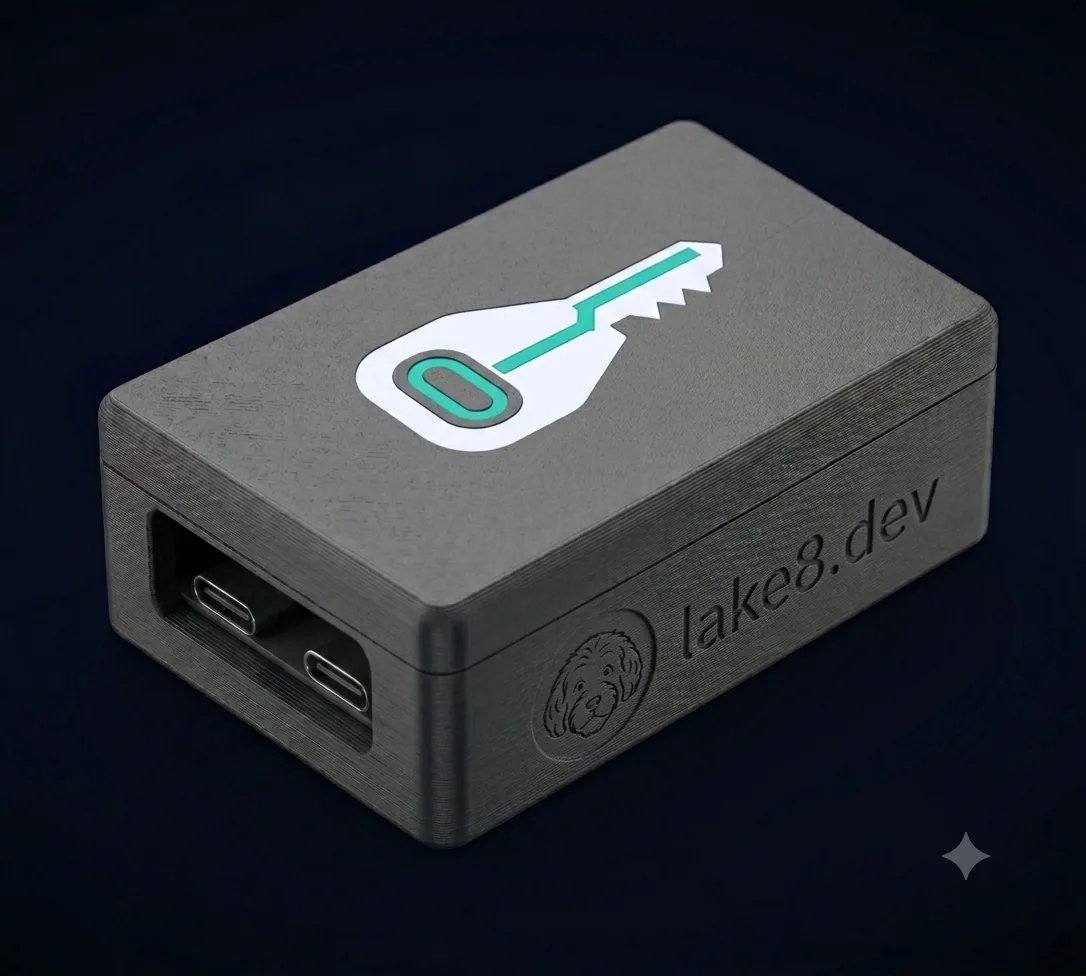
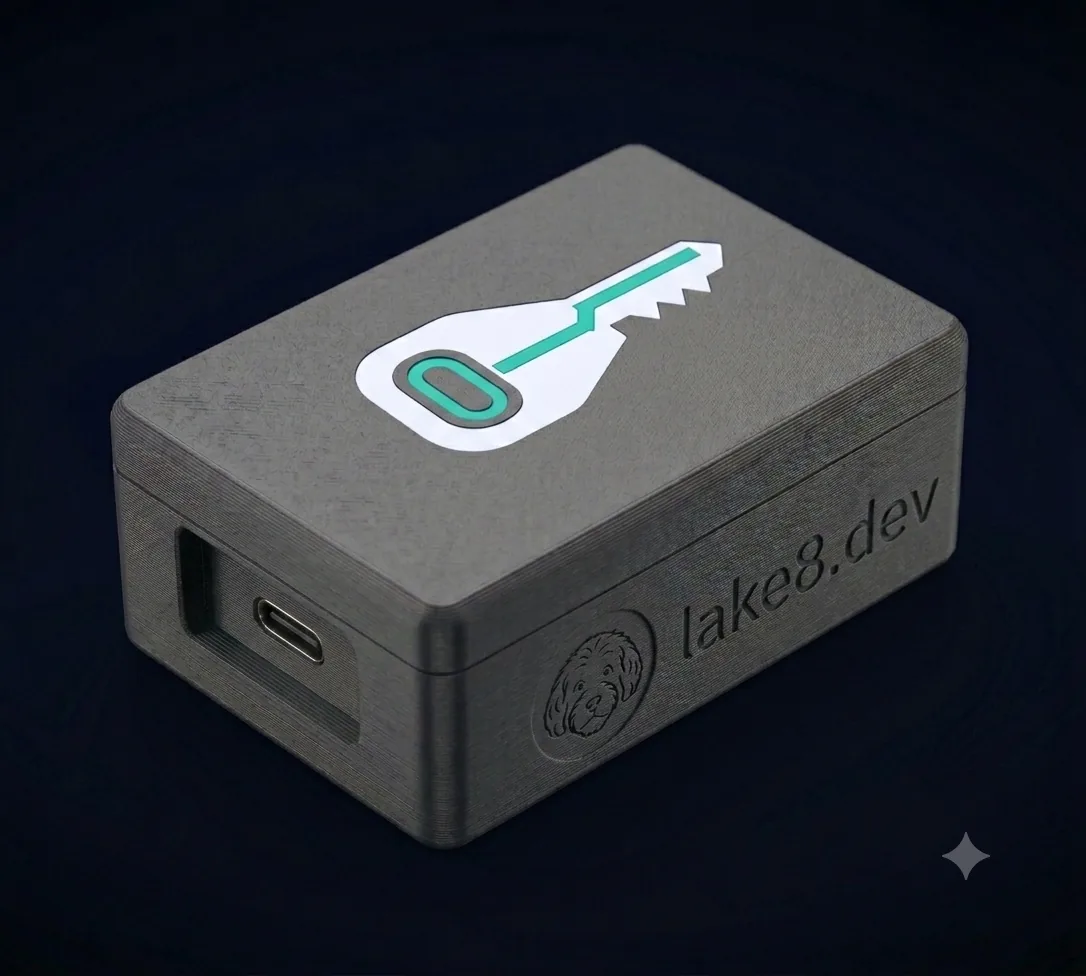
Renders of the case design — anthracite PLA, key logo on the lid, lake8.dev marking on the side.
Unplugging the dongle is the revocation mechanism — the session closes in under 5 seconds. No console, no network call, no waiting for a session to expire. Wait at least 5 seconds before reconnecting, to be sure the chip fully powered down.
The licence server is contacted at activation, then only for annual renewal, for registering a backup dongle (one per calendar year) and for transferring the licence to a replacement dongle — at most three times a year. Decryption works forever on your existing files: no network, no expiry. New encryption requires an active licence (€30/year).
The root secret never leaves the chip. lake8.dev cannot decrypt your files — not by policy, but because it is technically impossible.
Read the threat model for an explicit account of what Crypt-in does not protect against.
Whichever route you take, the part that matters is identical: we sell the activation, not the keys.
We ship it ready: assembled, flashed and tested. The factory test ends by erasing NVS, so the keys it generated are destroyed before the dongle is boxed.
Any ESP32-S3 becomes a Crypt-in dongle. Buy it wherever you like: we have no idea where your chip came from, and no reason to.
We ship hardware with firmware, no keys and no identity. Your dongle has no secrets until you power it on.
At first boot your dongle generates its own keys from hardware entropy. That moment happens in your hands, not ours.
lake8.dev has never seen your seed.
lake8.dev cannot see your seed.
Not even if you buy the Kit.
The full sequence is documented step by step in First Boot Key Generation.
At activation you also choose how much you tell us about yourself: an anonymous activation sends no email, no name and no tax ID. See the full activation model →
The 24-word recovery seed works like a crypto wallet. Write it down. Store it safely. Never share it. If you lose it we cannot help — and neither can anyone else. That is the guarantee.
Buy a dongle. Write down your 24 words and PIN. Encrypt your files. Upload them to Google Drive — publicly, if you want. Verify everything opens. Destroy the dongle.
Four years later, buy a €5 chip. Type your 24 words. Your files open.
The dongle lived for 10 minutes. The encryption lasted forever.
And one more thing. Nobody memorises 24 random words. You cannot be made to recite what was never in your head — the secret is on a piece of paper, not in your memory.
That is not protection from coercion, and we do not claim it is: the threat model says plainly that no technology is. Where the paper lives stays a human problem.
Upload your secrets to Google Drive. Nobody can open them.Not even us.